


As business networks become increasingly complex, understanding how Internet resources are used is essential for maintaining security, operational efficiency, and control. Cloud applications, remote working environments, connected devices, and distributed infrastructures have significantly expanded the digital footprint of modern organizations.
For IT administrators and security teams, this evolution introduces an important challenge: maintaining visibility into network activity while protecting users, devices, and business-critical information.
Internet usage reporting addresses this need by providing structured information about how Internet connectivity is used across an organization’s network. From identifying frequently accessed domains to detecting potentially suspicious activity, these reports help businesses make informed decisions about network management and cybersecurity.
But what exactly does internet usage reporting involve, and how can organizations use it to strengthen their security posture?
What Is Internet Usage Reporting?
Internet usage reporting is the process of collecting, analyzing, and presenting data about Internet activity within a network. It enables IT teams to understand how users, devices, and applications interact with online resources over a specific period.
An internet usage report typically organizes network activity into measurable information, allowing administrators to identify usage patterns, investigate unusual events, and evaluate compliance with internal Internet access policies.
Depending on the monitoring technology deployed, these reports may include information about visited websites, requested domains, connection timestamps, network traffic volumes, and security-related events.
For organizations managing multiple locations, remote employees, or distributed IT environments, centralized reporting can provide a consolidated view of Internet activity across different network segments.
Internet usage reporting is therefore more than a record of online activity: it is a source of operational intelligence that supports network visibility, security management, and informed decision-making.
Internet Usage Reporting vs. Internet Usage Monitoring
Although the terms are frequently used interchangeably, internet usage monitoring and internet usage reporting describe two complementary activities.
Internet usage monitoring refers to the continuous observation and collection of network activity data. Monitoring solutions capture events such as connections, DNS requests, traffic flows, or attempts to access specific online resources.
Internet usage reporting, on the other hand, transforms collected data into structured information that IT administrators can interpret and use.
Monitoring provides the underlying data, while reporting makes that data actionable through dashboards, summaries, historical analysis, and other analytical tools.
Together, these capabilities help organizations move from basic network observation to a more informed approach to Internet governance.
What Information Can Internet Usage Reports Provide?
The information contained in an internet usage report depends on the technology used to collect network activity data and the level of visibility available.
Different reporting solutions provide different perspectives on Internet usage, ranging from domain-level activity to detailed network traffic analysis.
1. Websites and Domains Accessed
One of the most common objectives of internet usage reporting is understanding which online resources are accessed from a corporate network.
Reports may identify frequently requested domains, access trends, and attempts to reach websites associated with particular content categories.
This information helps IT administrators evaluate whether Internet activity aligns with organizational policies and identify potentially risky destinations.
However, the level of detail varies. DNS-based reporting can identify requested domains, while more granular visibility into individual URLs may require proxy-based monitoring or other inspection technologies.
2. Internet Activity by User, Device, or Network
Organizations often need to understand where Internet activity originates.
Depending on the monitoring architecture and available identity integrations, reporting systems may associate activity with specific users, devices, IP addresses, departments, or network locations.
This level of visibility is particularly valuable for companies operating distributed infrastructures or managing multiple offices.
For Managed Service Providers (MSPs), it can also support the centralized supervision of different customer environments.
3. Timestamps and Usage Patterns
Internet activity reports can provide historical information about when network events occur and how usage patterns evolve over time.
By analyzing timestamps and recurring activity, IT teams can identify unusual access attempts, investigate incidents, and understand how network resources are used during different periods.
Historical reporting also supports troubleshooting and helps administrators correlate network activity with operational or security events.
4. Bandwidth Consumption and Network Traffic
Some internet usage reporting solutions provide metrics related to bandwidth utilization, data transfer volumes, and network throughput.
These measurements help organizations identify bandwidth-intensive applications, evaluate network capacity, and investigate performance issues.
However, bandwidth reporting generally requires technologies capable of measuring traffic flows or transferred data.
DNS reporting alone does not measure the volume of data exchanged during an Internet session.
5. Blocked Requests and Security Events
Security-oriented reporting solutions may record attempts to access malicious or restricted destinations.
These events can include requests associated with phishing websites, malware distribution, suspicious domains, or content categories restricted by corporate security policies.
Analyzing blocked requests helps security teams evaluate policy enforcement and identify recurring exposure to online threats.
When combined with threat intelligence, these reports can provide valuable context for cybersecurity investigations.

Why Do Businesses Need Internet Usage Reporting?
Internet usage reports support several operational and security objectives. Their value extends beyond understanding which websites are accessed: they help organizations improve visibility, reinforce governance, and make more informed technology decisions.
Strengthening Cybersecurity and Threat Detection
Internet activity can provide useful indicators of potential security incidents.
Repeated requests to suspicious domains, unusual access patterns, or attempts to reach known malicious destinations may indicate exposure to phishing, malware, or other cyber threats.
Although reporting does not automatically establish that a device has been compromised, it provides contextual information that security teams can investigate.
By integrating Internet activity data into security operations, organizations can improve their ability to identify risks and support incident response.
Improving Network Visibility and Operational Control
Modern business networks include cloud platforms, SaaS applications, remote endpoints, and multiple Internet-connected devices.
Without adequate reporting, administrators may struggle to understand how these resources interact with external services. Internet usage reporting helps IT teams maintain greater visibility across their infrastructure, evaluate access patterns, and identify potential gaps in network governance.
For organizations undergoing digital transformation, this visibility becomes increasingly relevant as IT environments grow in complexity.
Supporting Internet Access Policies
Organizations often implement Internet access policies to reduce security risks and establish appropriate use of corporate resources.
Reporting helps administrators evaluate how these policies operate in practice.
For example, reports can highlight repeated attempts to access restricted content categories or identify network segments where additional controls may be necessary.
This supports a more consistent approach to policy management across departments, offices, and distributed environments.
Supporting Compliance and Accountability
Internet usage reporting may also contribute to internal audits, security assessments, and compliance-related activities.
Historical activity records can help organizations document the operation of certain network controls and investigate security events.
However, collecting Internet activity data also introduces privacy and data protection responsibilities.
Organizations must consider applicable regulations, employee privacy, data retention requirements, and access permissions when implementing monitoring and reporting systems.
In environments subject to the European Union’s General Data Protection Regulation (GDPR), the processing of identifiable Internet activity data must be assessed against the relevant legal requirements.
Reporting should therefore be implemented with clear purposes, appropriate safeguards, and proportionate data collection practices.
Internet Usage Reporting Methods and Tools
There is no single technology capable of providing every type of Internet usage information.
Organizations typically select reporting tools according to their infrastructure, security objectives, and required level of detail.
The following technologies represent some of the most common approaches.
DNS Logging and Reporting
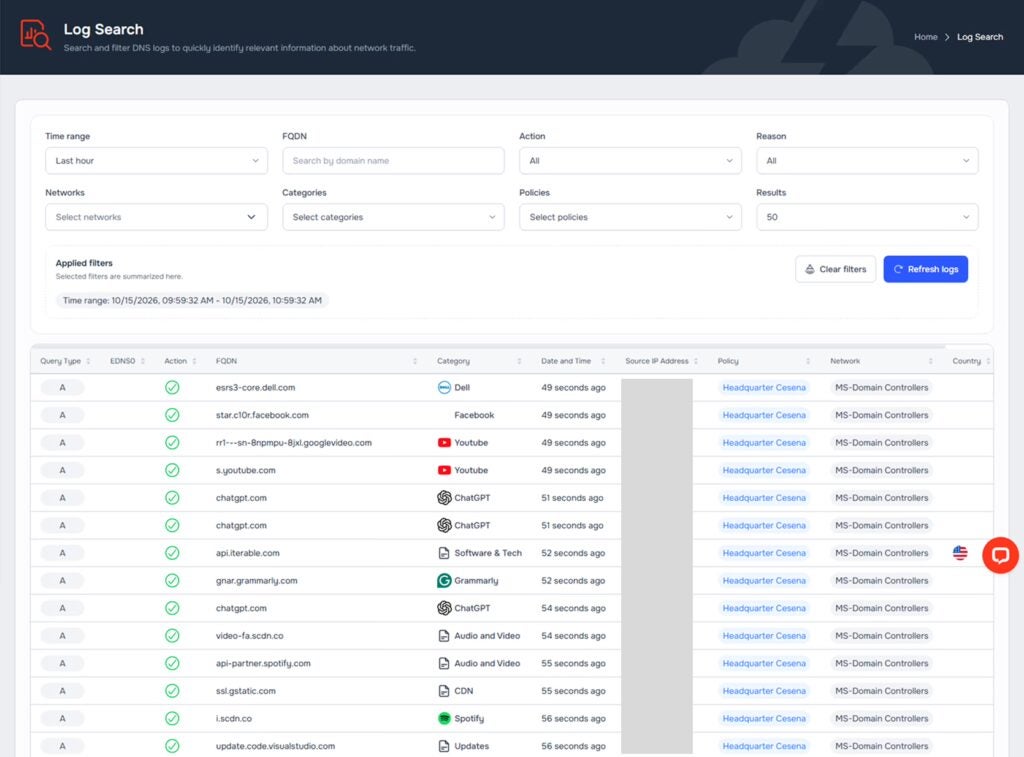
The Domain Name System (DNS) translates domain names into the IP addresses required to reach online services. Since many Internet interactions involve DNS resolution, DNS logging and reporting provide valuable visibility into domain requests, timestamps, and DNS-related security events.
By analyzing DNS activity, IT administrators can identify frequently requested domains, investigate suspicious requests, and detect attempts to access known malicious destinations. This makes DNS reporting particularly valuable for domain visibility, security monitoring, and threat investigation.
However, its effectiveness depends on factors such as DNS traffic visibility, endpoint configuration, identity attribution, and the use of encrypted or alternative DNS resolution mechanisms.
It is also important to recognize that DNS logs do not provide a complete browsing history. A DNS request does not necessarily confirm that a website was successfully visited, and some connections may occur without a new DNS query.
Firewall Reporting
Firewalls monitor and control network traffic according to predefined security policies. Their reporting capabilities provide information about network connections, source and destination addresses, protocols, traffic statistics, and policy enforcement events, including blocked connection attempts.
Firewall reporting is particularly useful for network security and access control, allowing IT administrators to analyze communication patterns, identify unauthorized connection attempts, and evaluate the effectiveness of security policies.
The level of application-specific information available depends on the firewall’s inspection capabilities and configuration.
Proxy-Based Reporting
Web proxies provide visibility into HTTP and HTTPS activity when the relevant traffic passes through them. Depending on their deployment model and inspection capabilities, proxy reports may include web requests, requested URLs, access timestamps, content categories, and policy violations.
This makes proxy-based reporting particularly useful for web activity analysis and content control, helping organizations monitor access to online resources, investigate browsing activity, and enforce corporate Internet usage policies.
Organizations requiring detailed web activity reporting may combine proxy solutions with other network monitoring technologies. However, visibility into encrypted traffic depends on the technical architecture and must account for privacy requirements and applicable security policies.
NetFlow and IPFIX
NetFlow and IPFIX are technologies designed to collect and analyze network traffic flow information. They provide data about communication endpoints, protocols, traffic patterns, and transferred data volumes, enabling IT teams to understand how network resources are being used.
These technologies are particularly valuable for bandwidth analysis, traffic monitoring, and capacity planning. By examining traffic flows, administrators can identify bandwidth-intensive communications, investigate network performance issues, and optimize infrastructure resources.
Unlike DNS reporting, which focuses on domain resolution activity and can support DNS-level security analysis, NetFlow and IPFIX primarily provide visibility into network traffic characteristics rather than domain categorization or threat prevention.
How to Choose an Internet Usage Reporting Solution
Selecting the appropriate internet usage reporting software requires organizations to evaluate more than the quantity of data collected.
The objective should be to obtain relevant, reliable information that supports operational and security decisions without introducing unnecessary management complexity.
Several factors deserve particular attention.
Visibility and reporting granularity: Determine whether the organization needs domain-level information, individual URL visibility, user attribution, bandwidth metrics, or a combination of these capabilities.
Centralized management: For distributed organizations and MSPs, centralized access to reporting information can reduce operational complexity and improve consistency across different environments.
Security integration: Reporting becomes more valuable when it can be correlated with threat intelligence, security policies, and other cybersecurity controls.
Scalability and performance: The reporting architecture should support growing numbers of users, devices, and network locations without creating unnecessary performance bottlenecks.
Data protection and retention: Administrators should evaluate access permissions, retention periods, data minimization, and other controls relevant to the protection of activity records.
Operational efficiency: Dashboards, search capabilities, historical analysis, and supported data exports can help IT teams reduce the time required to investigate network events.
For MSPs and IT service providers, additional considerations may include customer-level separation, delegated administration, and the ability to deliver consistent security services across multiple organizations.
Ultimately, the most appropriate solution depends on the type of visibility required and how reporting information will be used.
DNS Reporting: Turning Internet Activity Data into Security Insights
Traditional internet usage reports help organizations understand how Internet resources are used.
However, visibility alone does not prevent users or devices from attempting to reach malicious destinations.
This distinction becomes particularly important when Internet activity reporting is considered as part of a broader cybersecurity strategy.
How can organizations move from understanding Internet activity to actively reducing exposure to online threats?
One approach is to combine DNS-level visibility with DNS filtering and threat intelligence.
DNS reporting provides information about domain resolution requests, while DNS filtering can enforce security policies before connections to prohibited or known malicious domains are established.
The importance of DNS security is also illustrated by a 2026 incident reported by BleepingComputer, in which attackers manipulated DNS settings on compromised Wi-Fi gateways to redirect users toward fraudulent Microsoft 365 login pages. The case highlights why protecting DNS infrastructure is an important component of a broader network security strategy.
In that sense, the combination of DNS Security and DNS reporting can support several important cybersecurity activities.
Identifying Potentially Malicious Domains
DNS activity may reveal requests associated with phishing campaigns, malware infrastructure, or other suspicious online resources.
When DNS requests are evaluated against continuously updated threat intelligence, organizations can identify potentially dangerous destinations and apply appropriate access controls.
Security teams can also use available DNS activity records to investigate recurring requests and assess whether additional endpoint analysis is necessary.
Understanding Blocked Access Attempts
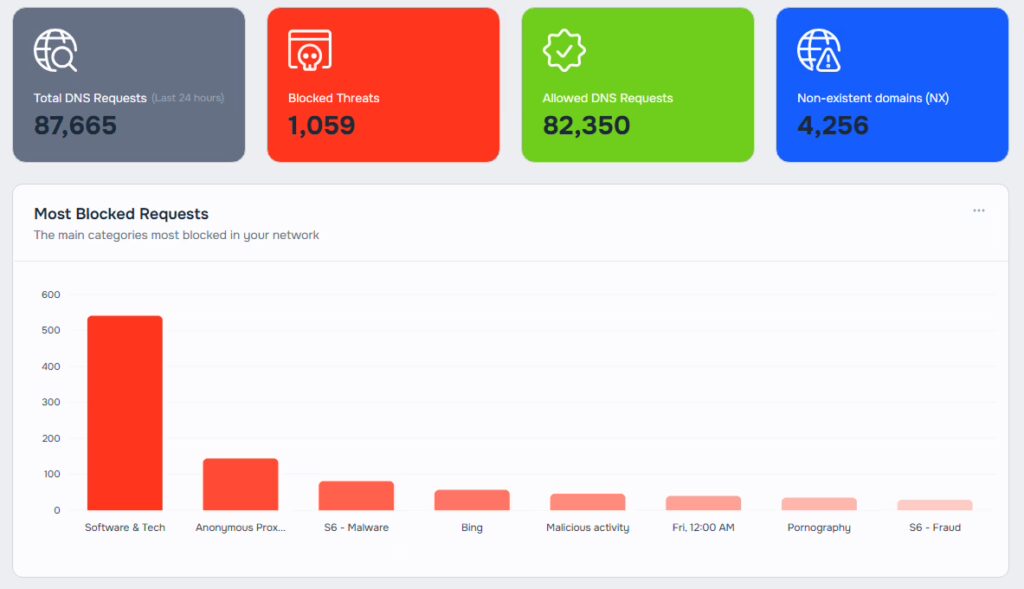
Reports of blocked DNS requests can help administrators understand which security policies are being triggered and which categories of online threats are being encountered.
For example, repeated attempts to resolve known malicious domains may justify further investigation of the originating device or network segment.
Blocked-request information can therefore contribute to security monitoring and policy optimization.
Improving Security Across Distributed Networks
For organizations managing multiple locations, DNS-based security controls can provide a consistent layer of protection across supported networks and devices.
Centralized policy management can help IT teams maintain coherent Internet access rules while reducing the administrative effort associated with distributed environments.
For MSPs, DNS filtering can also represent a valuable component of a broader managed cybersecurity service.
Nevertheless, DNS security should complement rather than replace endpoint protection, firewalls, and other security controls.
Internet Usage Reporting with FlashStart: From Network Visibility to Proactive Security
Understanding how Internet resources are used is an important part of network management. However, organizations need more than raw traffic data: they need structured insights that help identify security risks, evaluate browsing policies, and maintain control over their digital infrastructure.
FlashStart combines Internet Usage Reporting with cloud-based DNS filtering, providing organizations with detailed information about DNS activity alongside preventive protection against malicious and unwanted online destinations.
Real-Time Monitoring and Historical Internet Usage Reports
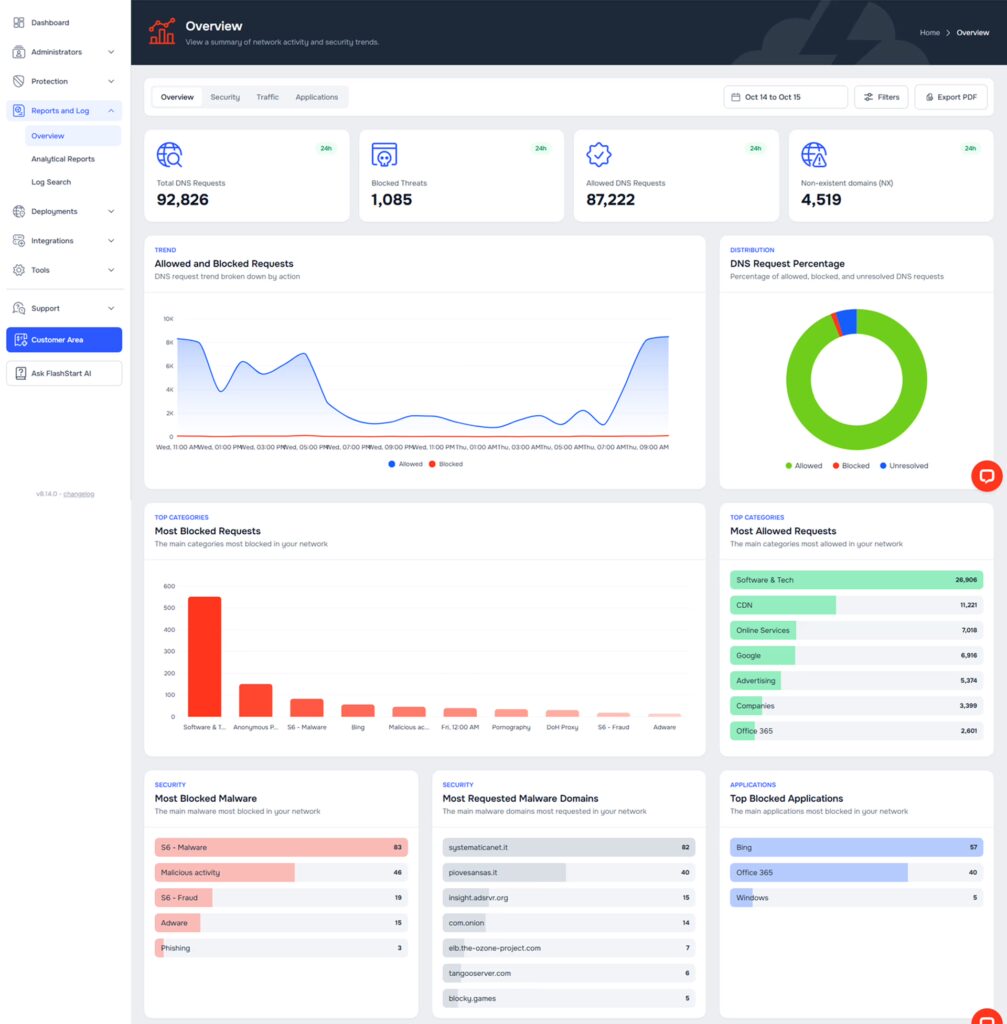
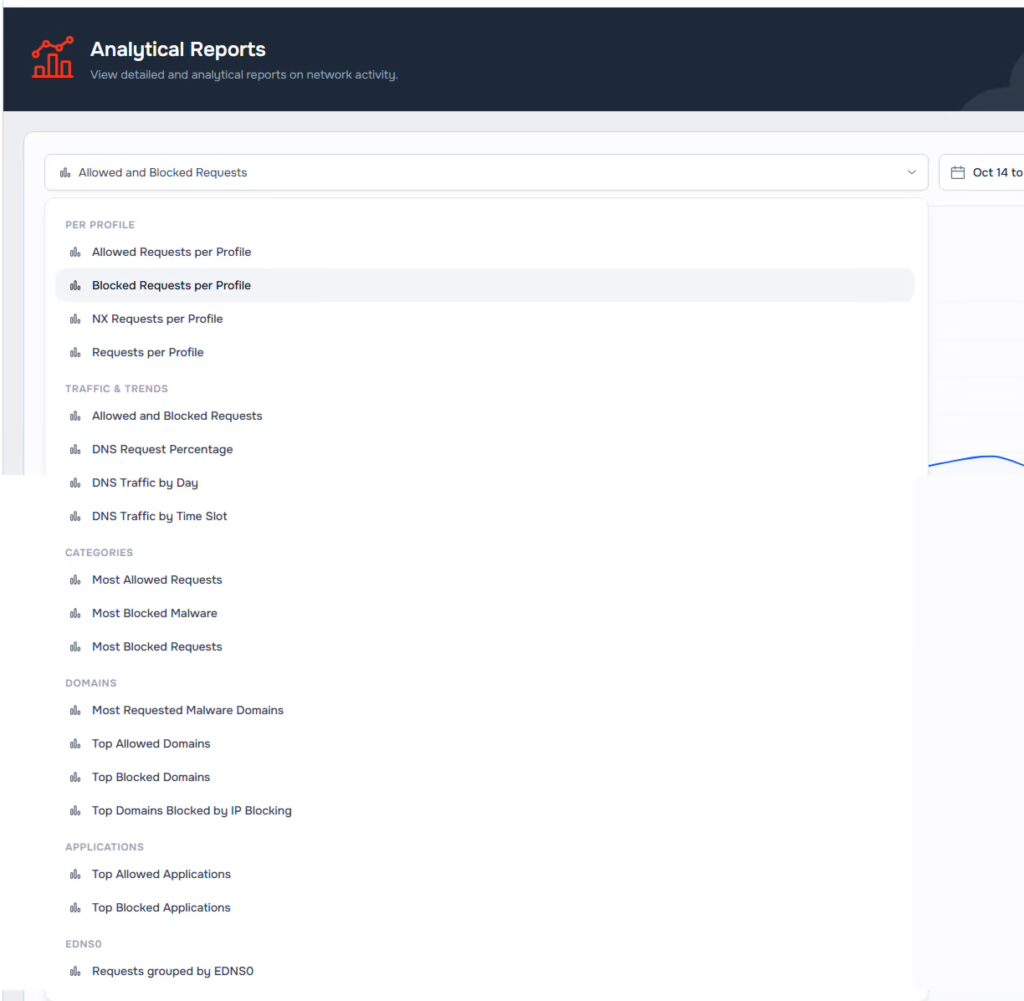
FlashStart provides more than 20 predefined reports covering Internet activity, blocked threats, content filtering, geolocation, and usage trends.
Through its centralized dashboard, IT administrators can analyze DNS requests in real time or review up to six months of historical data.
Reports provide visibility into several important aspects of network activity, including:
- Allowed and blocked DNS requests: Understand how Internet access policies are applied across the network.
- Malware and security events: Identify blocked malicious domains and investigate potentially dangerous requests.
- Content categories: Analyze access patterns involving different categories of online resources.
- Domain and geolocation information: Examine requested destinations and their geographical context.
- Time-based activity: Identify recurring trends and analyze network activity across different periods.
FlashStart also provides searchable DNS logs and analytical reports that can be exported in PDF format, supporting security reviews, troubleshooting, and operational analysis.
Centralized Reporting for Organizations and MSPs
Managing Internet activity becomes more complex when multiple networks, locations, or customers are involved.
FlashStart supports multi-tenant environments, allowing service providers to manage reporting independently for different customers while maintaining separation between their respective environments.
For MSPs, this capability can support more consistent service delivery, improve operational visibility, and provide useful information for customer security reviews.
At the same time, FlashStart’s reporting approach is designed to respect user privacy, avoiding the retention and analysis of individual personal browsing data as described in its reporting documentation.
Combining Internet Usage Reporting with DNS Threat Prevention
What makes Internet usage reporting more valuable for cybersecurity?
The ability to connect network visibility with preventive security controls.
FlashStart’s DNS filtering technology evaluates domain requests against security policies and threat intelligence, helping prevent access to malicious destinations associated with phishing, malware, and other online threats.
Its reporting capabilities then provide administrators with information about blocked requests, security events, and Internet access patterns.
This combination helps organizations move beyond passive monitoring toward a more proactive approach to network protection.
Discover FlashStart Network Usage Reporting and see how DNS visibility, centralized reporting, and threat prevention can strengthen your Internet security strategy.
Frequently Asked Questions About Internet Usage Reporting
What is an internet usage report?
An internet usage report is a structured summary of Internet activity collected from a network. Depending on the monitoring solution, it may include requested domains, connection events, timestamps, bandwidth consumption, and security-related information.
How can I monitor internet usage on my network?
You can monitor Internet usage through technologies such as DNS logging, firewall reporting, proxy servers, and network flow monitoring. The appropriate approach depends on whether you need visibility into domains, web requests, traffic volumes, or security events.
Can internet usage reports show visited websites?
Some reporting solutions can identify visited websites or requested URLs, depending on their inspection capabilities. DNS-based reporting generally identifies requested domains rather than complete browsing histories or individual page URLs.
What is the difference between internet usage reporting and bandwidth monitoring?
Internet usage reporting is a broader concept that may include web activity, domain requests, security events, and traffic statistics. Bandwidth monitoring specifically measures network data consumption and transfer rates.
Can DNS logs be used to monitor Internet activity?
Yes. DNS logs can provide information about domain resolution requests and related activity. However, they do not capture every Internet connection or prove that a particular website was successfully visited.
How can MSPs use internet usage reporting?
MSPs can use reporting information to support network supervision, investigate security events, document service activity, and identify potential risks across customer environments. The available reporting capabilities depend on the technologies deployed and their management architecture.