

Every day, the web gains a vast amount of new domains, pages, and content. If you manage cybersecurity for an enterprise, an ISP, or an MSP, the challenge is immediate: how do you apply a policy to a domain the system does not know yet? This is where FlashStart’s AI Domain Classification comes into play.
When determining the category of new content, keywords can provide an initial signal. Still, they are rarely sufficient to distinguish context: an article discussing gambling and an active betting portal often share vocabulary while serving entirely different purposes.
Contextual classification addresses this challenge by analyzing the relationships between words across the page, rather than merely tracking their occurrence. This is the approach adopted by FlashStart thanks to the implementation of DeBERTa-v3-base, fine-tuned to achieve higher precision and contextual accuracy.
The Architecture of FlashStart’s AI Pipeline: From Web Domain to Contextual Inference
The system processes unknown domains through a modular pipeline featuring an initial pre-crawling check followed by three AI-processing stages. Each stage has a separate responsibility, ensuring that the final classification can be traced back to the original source content. The pipeline has been designed as follows:
- Pre-crawling: applies configured decision gates before any AI processing begins.
- Crawl: retrieves the rendered content of the submitted domain and extracts representative text.
- Preprocessing: removes content unsuitable for inference, normalizes the extracted text, and translates it into English.
- Classification: submits the prepared text to the DeBERTa-v3-base model and generates ranked category predictions.
This streamlined workflow allows FlashStart’s policy systems to analyze and classify new domains on the fly in seconds, keeping relevant data for analysis and reporting.
Pre-Crawling Decision Gates: Fast and Deterministic Rule-Based Filtering
Before a domain enters the AI pipeline, the pre-crawling mechanism evaluates configured decision gates. A gate can classify a domain immediately, skip it, or pass it forward to crawling. In this way, immediate and high-confidence decisions are obtained for known cases, preserving computing resources and avoiding latency.
The current implementation includes a dedicated known-TLD gate: a “fast-track” rule that classifies a website based purely on its domain extension, delivering speed and accuracy. Domains that do not match a configured gate automatically advance to the next stages of the pipeline, ensuring a flexible architecture designed for continuous evolution.

Next-generation DNS protection, fully cloud & AI-based and easy to activate
Targeted Web Crawling: Building an Accurate Textual Representation of the Page
The crawler opens the requested URL in an isolated browser session. This allows it to capture dynamic, interactive content just like a real browser, following redirects while staying focused strictly on that specific website.
Rather than wasting bandwidth downloading heavy media files, advertising trackers, or secondary scripts, FlashStart’s crawler strategically extracts the essential signals that best define the site’s meaning and activity through:
- Page Metadata: Title, meta description, and main headings that provide an immediate thematic indicator.
- Main Body Content: Contextual text that allows the AI to capture nuances essential for distinguishing pages with generic or similar titles.
The crawler stores the cleaned extracted text, page response status, requested URL, and rendered content to ensure full traceability. Intelligent quality control mechanisms promptly identify non-content events, recording them as mere operational statuses rather than forcing artificial categorizations.
Furthermore, extracted text is normalized and capped at a limited number of characters, filtering out repetitive navigation menus and superficial boilerplate content before passing it to the model’s tokenizer.
Content Preprocessing: Text Normalization and Multilingual Consistency
Preprocessing transforms the raw crawl output into a standardized input optimized for deep learning. By combining automated text cleaning with multi-language translation, FlashStart isolates the core semantic meaning of each website.
During extraction, whitespace is standardized and raw URL strings are removed. This ensures that the classifier learns from genuine narrative content rather than superficial technical identifiers, such as CDN paths, tracking parameters, or affiliate tags.
Next, the normalized text is translated into English while preserving the detected original language in the metadata. This unified linguistic approach enables the deep learning model to deliver consistent, high-accuracy classification across global domains in any language. Retaining both the original extracted text and the English translation guarantees full auditability for compliance and review purposes. This stage also functions as a “quality gate”: content must meet clear completeness and readability thresholds before progressing to inference, ensuring that the AI model operates exclusively on robust, representative data.
Next-generation DNS protection, fully cloud & AI-based and easy to activate
Contextual Sequence Classification with DeBERTa-v3-base
For the classification stage, FlashStart leverages DeBERTa-v3-base. Compared to traditional transformer architectures, DeBERTa adopts a disentangled attention mechanism that evaluates lexical content and the relative position of words separately, capturing the syntactic and semantic dependencies of the sequence with extreme precision. This contextual understanding enables the model to accurately differentiate subtle nuances, such as distinguishing an informative article on cybersecurity from an active phishing threat.
Before inference, the text is tokenized and truncated to the context length supported natively by the model. The algorithm then calculates probability scores across the 18 categories of the taxonomy chosen by FlashStart.
Each classification provides the following structured domain intelligence:
- Top Category: The primary classification with the highest relevance score.
- Confidence Score: A relative confidence value reflecting the model’s certainty for the primary classification.
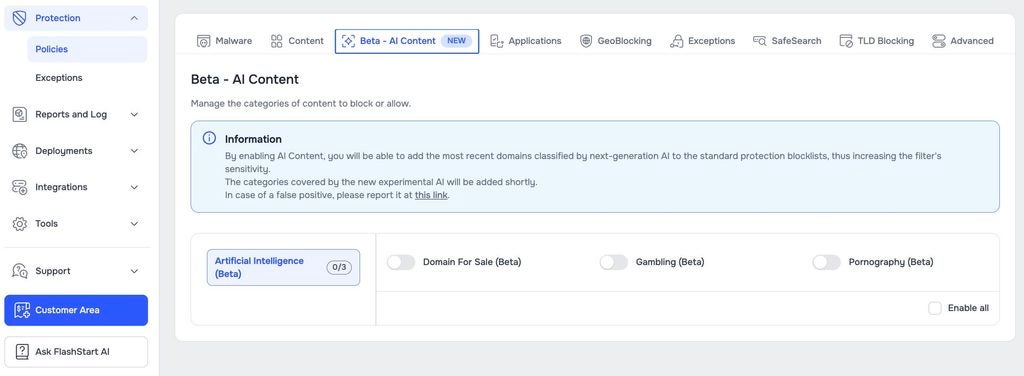
- Ranked Predictions: Currently supporting three candidate categories labelled as domainforsale, gambling, and pornography, enabling downstream systems to promptly evaluate ambiguous cases.
- Inference Provenance: Traceable references linking the final classification to the original crawl, translated text, and exact timestamp.
Actionable Intelligence and Continuous Innovation
FlashStart deliberately separates AI classification from policy enforcement: while the model provides rich domain intelligence, you retain full control over how policies are enforced across your network. Security teams can establish tailored confidence thresholds, automating immediate blocking for high-confidence threats while routing lower-confidence or nuanced categories into monitoring or review workflows.
To maintain cutting-edge accuracy as web threats evolve, FlashStart continuously optimizes the classification capability of its AI model using real-world telemetry, representative validation sets, and active learning pipelines.
Ready to elevate your DNS security? Try the new FlashStart AI Domain Classification feature today and bring next-generation threat protection to your security stack. To learn more about configuration and integration, visit our official documentation.
Next-generation DNS protection, fully cloud & AI-based and easy to activate
Frequently Asked Questions (FAQ)
What is the advantage of FlashStart’s AI Domain Classification service?
The core value of the service lies in enhancing the sensitivity and responsiveness of your DNS protection: powered by next-generation AI, newly registered or previously unknown domains are promptly analyzed and classified into the three key categories of this release: Domain For Sale, Gambling, and Pornography.
Does this AI feature directly apply DNS blocking rules?
No. The AI component generates domain intelligence, while FlashStart’s policy engine enforces your organization’s specific filtering rules, confidence thresholds, and access controls. The feature can be enabled at the administrator’s discretion.
Does the crawler perform a full website crawl?
No. The crawler only retrieves the requested page and follows legitimate redirects. It does not crawl external links or navigate across additional pages, keeping the analysis fast, predictable, resource-efficient, and saving bandwidth.
How does the system handle unreachable domains or empty pages?
If a domain fails to resolve, such as a connection timeout, the pipeline records a mere operational status rather than forcing an inaccurate content category. This preserves model integrity and reduces false positives.