

Cybersecurity controls are usually evaluated by what they can detect, block, or prevent. Network infrastructure is measured differently: latency, response time, availability, throughput, and resilience determine whether a service can operate effectively at scale.
DNS security sits at the intersection of these two worlds.
When DNS is used not only to resolve domains but also to evaluate destinations against security intelligence and policies, every DNS query can become a small security decision. That decision must be accurate, but it must also be fast.
This creates a fundamental engineering challenge: how can DNS security make increasingly sophisticated decisions without becoming slower?
In our previous analysis of DNS as a Policy Enforcement Layer, we examined how DNS can operate as an early security control within modern architectures. One characteristic makes this role particularly valuable: DNS can function as a low-latency security primitive, applying protection at a foundational layer of Internet communication. This evolution is also reflected in the latest NIST guidance on secure DNS deployment, which treats DNS as an integral component of enterprise network architecture and addresses its role within modern security strategies.
But describing DNS as low-latency raises another question.
What does it actually take for a security DNS service to remain low-latency while processing threat intelligence, policies, domain classifications, and billions of queries?
The answer goes beyond raw DNS speed. It involves resolver architecture, global network distribution, processing efficiency, scalability, availability, and the ability to integrate security intelligence without creating a performance bottleneck.
For enterprises, MSPs, ISPs, and telecommunications providers, DNS performance therefore becomes more than a network metric. It becomes part of security quality.
Low Latency Is Not Just About Faster DNS
A traditional discussion about DNS latency tends to focus on a simple metric: how much time passes between a DNS request and its response.
Lower DNS response time generally means that the client can proceed more quickly toward establishing the requested connection.
For a security-oriented DNS resolver, however, the equation is more complex.
The service may need to determine whether the requested domain is associated with malware, phishing, ransomware, botnets, command-and-control infrastructure, or other threats. It may also need to apply policies based on categories, users, devices, locations, or organizational requirements.
All of these capabilities create value.
They also require processing.
A high-performance DNS security service therefore has to optimize two objectives simultaneously:
- maximize the quality and speed of security decisions;
- minimize the latency required to deliver them.
This is why simply comparing a security resolver with a conventional DNS resolver based on raw response time does not tell the entire story.
The real challenge is delivering DNS security performance: combining protection, intelligence, scalability, and low latency within the same infrastructure.

Next-generation DNS protection, fully cloud & AI-based and easy to activate
The Security-Performance Paradox
Security technologies frequently introduce additional processing into network communications.
This trade-off is particularly relevant in DNS. As Infosecurity Magazine has highlighted in the context of encrypted DNS, additional security mechanisms can increase processing requirements and create new performance considerations for DNS infrastructure.
More analysis can provide greater visibility. But more processing can also create overhead.
For DNS security, this produces what we can call a security-performance paradox.
Organizations want increasingly sophisticated protection against rapidly evolving threats. At the same time, DNS is an infrastructure service expected to respond almost instantaneously.
The security engine therefore needs to become more intelligent without making the resolver perceptibly slower.
This is particularly challenging because the threat landscape itself is becoming more dynamic. Malicious domains can be created quickly, phishing infrastructure can operate for short periods, legitimate services can be compromised, and attackers can continuously modify their infrastructure.
Static domain lists alone are not enough to respond to this environment.
Modern DNS protection increasingly depends on continuously updated threat intelligence, automated domain classification, behavioral signals, Artificial Intelligence, and Machine Learning.
But all of this intelligence ultimately has to support a decision that users expect to happen in milliseconds.
Can you increase security intelligence without increasing security friction?
For a low-latency DNS architecture, that is one of the fundamental design objectives.
From DNS Response Time to Security Decision Latency
This leads to a useful distinction.
For a conventional DNS resolver, we can think primarily in terms of DNS response time.
A request is received, the domain is resolved, and a response is returned.
For a security DNS resolver, it is useful to think more broadly in terms of security decision latency.
Conceptually, the process becomes:
DNS query → security intelligence → policy evaluation → decision → DNS response
Not every implementation performs these operations sequentially or in exactly this way. High-performance architectures use caching, optimized data structures, distributed processing, pre-classification, and other techniques to minimize processing overhead.
But the conceptual distinction remains valuable.
The DNS response is no longer simply an infrastructure answer.
It may also represent a security decision.
This means DNS latency can become an indicator of how efficiently the security infrastructure performs that decision at scale.
A high-quality security DNS service should therefore not be evaluated solely according to how much intelligence it possesses. It should also be evaluated according to how efficiently that intelligence can be translated into protection.
In other words:
The objective is not simply more security intelligence. It is more security intelligence per millisecond.
That is what makes performance strategically relevant.
Next-generation DNS protection, fully cloud & AI-based and easy to activate
What Makes a Security DNS Fast?
There is no single component responsible for DNS resolver performance.
Several architectural factors contribute to the final response time experienced by users.
Resolver Architecture
The resolver itself must process large numbers of queries efficiently.
At enterprise scale, and particularly in ISP or telecommunications environments, query volumes can become extremely high. Infrastructure must therefore be designed to sustain peak loads without producing significant degradation in DNS response time.
Caching
DNS caching reduces the need to repeat resolution processes for frequently requested domains.
Effective caching can significantly improve performance, although security DNS services must balance cache efficiency with the need to maintain updated security information.
A domain considered legitimate yesterday may become compromised today. Performance optimizations therefore cannot come at the cost of stale threat intelligence.
Processing Efficiency
Security rules and domain classifications need to be accessible quickly.
If every request required slow, remote, or computationally expensive analysis before receiving an answer, the DNS security layer could become a bottleneck.
This makes the architecture of the security intelligence itself relevant to DNS filtering performance.
Network Distance
Even an extremely fast resolver can appear slow if the request has to travel through inefficient routes or across significant geographical distances.
Network proximity therefore plays an important role in global DNS performance.
Capacity and Scalability
Performance measured with limited traffic does not necessarily indicate how the service will behave under sustained or rapidly growing query volumes.
A security DNS platform must be able to maintain low latency as the number of users, customers, devices, and queries increases.
This is particularly relevant for MSPs and ISPs, where infrastructure growth can be much faster than in a single enterprise network.
Why Milliseconds Matter at Scale
A few milliseconds may appear irrelevant when considering a single DNS query.
At scale, the perspective changes.
An enterprise may have thousands of users continuously accessing websites, SaaS platforms, APIs, collaboration tools, cloud services, and external resources.
Each activity can generate DNS requests.
An MSP may provide security services to hundreds or thousands of organizations.
An ISP or telecommunications provider may need to process requests generated by hundreds of thousands or millions of subscribers.
The relevant question therefore is not whether an individual user can consciously perceive a difference of a few milliseconds in a single DNS query.
The broader impact is operational. DNS performance and resilience can directly affect application accessibility, workforce productivity, customer experience, and, ultimately, overall business operations.
The more important question is:
Can the security infrastructure continuously process enormous volumes of decisions without becoming a bottleneck?
This is where DNS performance becomes an architectural requirement.
Latency also affects how a security service can scale commercially.
For an ISP or MSP, adding a security capability to an existing service creates value only if that capability can grow with the customer base without degrading the quality of connectivity.
Performance therefore has both a technical and a business dimension.
A scalable security service needs to maintain:
- predictable DNS response times;
- high availability;
- consistent performance across geographic regions;
- sufficient capacity for traffic peaks;
- effective security classification;
- operational efficiency as query volumes grow.
At that point, low-latency security becomes part of the service provider’s value proposition.
Next-generation DNS protection, fully cloud & AI-based and easy to activate
AI and Threat Intelligence Without a Latency Penalty
Artificial Intelligence and Machine Learning are increasingly important for identifying patterns across large domain populations and accelerating the classification of suspicious destinations.
However, AI does not eliminate the performance challenge.
It can actually make the underlying architectural requirement more demanding.
A DNS security platform may continuously analyze new domains, reputation signals, suspicious patterns, threat indicators, and other information. But the real-time query path still needs to remain extremely efficient.
The objective is therefore not necessarily to run a complex AI model from scratch for every DNS query.
A mature architecture can use AI and automated analysis to continuously enrich and classify security intelligence so that decisions can be applied efficiently when requests arrive.
This distinction is important.
Threat intelligence generation can involve sophisticated analysis.
Threat intelligence enforcement needs to remain extremely fast.
For a low-latency security primitive, the two capabilities need to work together.
FlashStart, for example, uses Artificial Intelligence and Machine Learning for the identification and classification of suspicious domains and analyzes approximately 200,000 new websites every day. At the same time, its infrastructure processes + 20 billion DNS queries per day.
The scale illustrates the challenge clearly: intelligence needs to evolve continuously while the query path remains optimized for speed.
Anycast and the Geography of Low-Latency Security
DNS latency is not determined exclusively by processing time. Geography matters.
A user in Milan, an office in São Paulo, a branch in New York, and a subscriber in Sydney should not all depend on a DNS server located in the same distant data center.
Network distance, routing quality, congestion, and the availability of nearby infrastructure can all influence DNS resolver latency.
Tests reported by Network World have shown how DNS performance can vary significantly by geography and provider, reinforcing the importance of resolver location and distributed infrastructure when evaluating global DNS latency.
This is why global DNS architectures commonly use Anycast.
With Anycast, multiple geographically distributed nodes can advertise the same service address. Network routing can then direct requests toward an appropriate available location.
For a security DNS platform, the benefits are significant.
A globally distributed Anycast infrastructure can help:
- reduce the distance between users and DNS nodes;
- improve DNS response times;
- distribute query loads;
- reduce dependence on a single data center;
- improve resilience during infrastructure failures;
- support consistent service across geographically distributed users.
But simply stating that a provider uses Anycast is not enough. The effectiveness of the architecture depends on the quality and distribution of the network, routing, capacity, redundancy, and how traffic is actually handled under real-world conditions.
This is why DNS performance benchmarks become important. Architecture should ultimately produce measurable results.
Fast Is Not Enough: Availability and Resilience Matter
The fastest DNS would have limited value if it were frequently unavailable.
DNS availability is also a business issue. As CSO Online has noted, DNS failures can make applications and digital services effectively unreachable, with consequences that extend from user experience to sales and brand reputation.
DNS is critical infrastructure. When DNS resolution fails, users may be unable to reach Internet services even if those services themselves remain fully operational.
For a security DNS service, the impact can be even more significant because DNS is also part of the protection architecture.
This means speed must always be considered together with availability and resilience.
Three dimensions are particularly important:
- Latency: How quickly does the resolver process and answer requests?
- Availability: How consistently can users reach the service?
- Security Effectivenes: How effectively does the service identify and enforce decisions against malicious or prohibited destinations?
Optimizing only one dimension is not enough. An extremely fast resolver without effective threat intelligence is not an effective security platform. A sophisticated security service with poor availability is not suitable as critical infrastructure.
And an accurate security resolver that introduces excessive latency can negatively affect user experience and operational performance.
The objective is balance.
Speed + availability + security intelligence are all part of DNS security quality.
Next-generation DNS protection, fully cloud & AI-based and easy to activate
How to Measure a Low-Latency Security DNS
Evaluating DNS security performance therefore requires looking beyond a single headline number.
Organizations should consider several indicators.
Average DNS Response Time
Average query time provides an initial indication of how quickly a resolver answers requests.
It should not, however, be considered in isolation.
Geographic Performance
A global organization needs to understand whether the service performs consistently across the regions where its users operate.
Excellent performance in one country does not automatically mean excellent performance worldwide.
Availability
Because DNS is a critical infrastructure service, uptime is fundamental.
Availability should be measured continuously rather than inferred from occasional testing.
Performance Consistency
Average values can hide significant variations.
A DNS resolver that usually responds quickly but periodically experiences severe latency spikes may create a worse operational experience than one with slightly higher but more predictable response times.
Query Capacity
Enterprises, MSPs, ISPs, and Telcos need to consider whether the platform can sustain large query volumes while maintaining performance.
Security Processing
For a security DNS, speed must be considered alongside the quality of threat intelligence and policy enforcement.
The goal is not simply to return an answer quickly. It is to return the right security decision quickly.
Independent Measurement
Finally, performance claims are more meaningful when they can be compared using independent measurement.
This is where a DNS benchmark becomes valuable.
Why Independent DNS Benchmarks Matter
Measuring DNS performance is complex because results can vary according to location, network conditions, routing, time of day, and testing methodology.
A measurement performed from a single office does not necessarily represent the experience of users around the world. Independent benchmarks provide a broader reference.
DNSPerf is an independent DNS performance monitoring service that compares providers through measurements from multiple locations worldwide. Benchmark data allows organizations to assess variables such as response time and availability and compare the performance of different DNS infrastructures under a common methodology.
For security DNS providers, this type of measurement is particularly valuable. A vendor can describe its architecture as fast, distributed, or resilient. An independent DNS performance benchmark helps determine whether those architectural choices translate into measurable results.
This distinction is important for technical decision-makers. Architecture is the claim. Performance is the evidence.
FlashStart: Security Decisions at DNS Speed
FlashStart’s architecture provides a concrete example of the relationship between security intelligence and DNS resolver performance.
The FlashStart cloud platform processes + 20 billion DNS queries every day, protects +32 million users, and continuously analyzes new domains using technologies that include Artificial Intelligence and Machine Learning.
The infrastructure is supported by a global Anycast network designed to distribute DNS requests and maintain high levels of performance and service continuity.
The significant point, however, is that this performance can also be measured independently.
According to a DigiCert PerfOps performance snapshot captured on August 10, 2026, FlashStart ranked #1 among the DNS resolvers included in the performance comparison at the time of measurement.
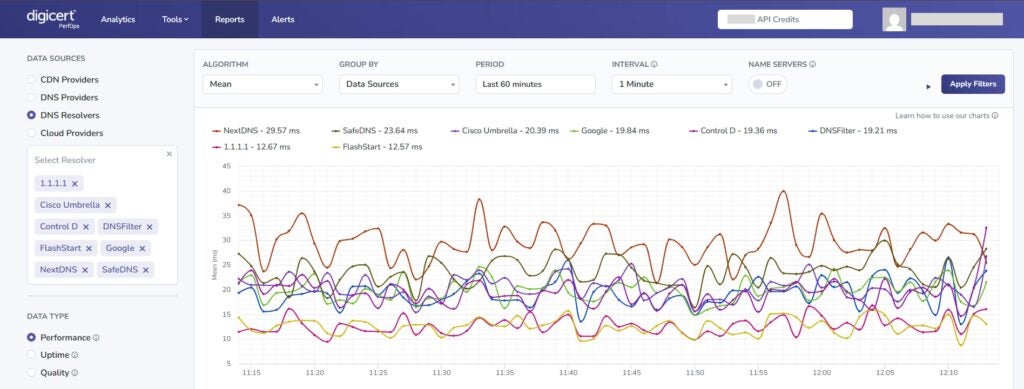
This result provides a current snapshot rather than a permanent ranking: DNS performance can vary over time according to measurement period, geography, routing conditions, and other network variables. For this reason, performance should be assessed through continuous and independent measurement rather than isolated vendor claims.
The result is also consistent with the broader performance profile independently monitored by DNSPerf, which tracks FlashStart DNS performance and uptime over time. DNSPerf’s global monitoring infrastructure tests DNS providers and resolvers every minute from more than 200 locations worldwide, providing continuously updated data on response times and availability.
For a security DNS provider, these measurements have significance beyond a simple speed ranking.
FlashStart is not operating as a conventional resolver whose only responsibility is returning DNS answers. Its platform combines DNS resolution with security intelligence, domain classification, policy enforcement, and content filtering while operating at very high query volumes.
The performance data therefore supports the broader architectural principle at the center of this analysis: advanced DNS security and high DNS performance do not have to be competing objectives.
A security platform can process large query volumes, continuously enrich its intelligence, and still maintain extremely low response times. That is what it means, operationally, to deliver security at DNS speed.
Next-generation DNS protection, fully cloud & AI-based and easy to activate
From “Fastest DNS” to Better Security Engineering
The phrase fastest DNS is immediately understandable, but speed rankings alone should not define how enterprises evaluate a DNS security provider.
The more meaningful question is what the infrastructure is accomplishing within that response time.
A resolver returning an answer in milliseconds is useful.
A security resolver capable of returning an informed, policy-aware security decision in milliseconds provides a different level of value.
This changes how we should think about DNS speed.
The goal is not simply: lower latency.
The goal is: lower latency while maintaining security effectiveness, global availability, and scalability.
This is why DNS filtering performance deserves to become a more visible criterion when organizations compare security platforms.
Cybersecurity teams traditionally focus on detection capability. Network teams focus on infrastructure performance.
DNS security requires both disciplines to converge.
What Enterprises, MSPs, and ISPs Should Expect
Different organizations will have different DNS requirements, but a high-performance security service should be evaluated through a combination of security and infrastructure metrics.
For an enterprise, important questions include:
- How quickly does the DNS resolver respond from the regions where employees operate?
- How consistently are security policies applied?
- What availability does the infrastructure provide?
- How quickly is threat intelligence updated?
- Can remote and distributed users receive comparable service quality?
- Does security filtering create a measurable performance penalty?
For MSPs, scalability becomes even more important.
The platform may need to support multiple organizations, policies, profiles, and user populations while maintaining consistent performance.
For ISPs and Telcos, the requirements increase again.
DNS protection may become part of the connectivity service itself. At that scale, DNS latency, infrastructure availability, query capacity, and operational efficiency directly influence the quality of the service delivered to customers.
Security cannot become a bottleneck for growth.
It needs to scale with the network.
DNS as a Low-Latency Security Primitive: A Performance Requirement
Calling DNS a low-latency security primitive should therefore mean more than saying that DNS operates early in Internet communications.
It should define an engineering requirement.
A low-latency security primitive must be capable of making security decisions continuously, across large user populations and geographic regions, without introducing unnecessary friction into the infrastructure it protects.
That requires:
- efficient DNS resolver architecture;
- globally distributed infrastructure;
- optimized routing;
- scalable processing capacity;
- continuously updated threat intelligence;
- fast policy evaluation;
- high availability;
- measurable performance.
The security industry increasingly expects controls to become more intelligent.
Users simultaneously expect digital services to become faster.
DNS security has to satisfy both expectations.
What defines the best-performing security DNS: the amount of intelligence it can process or the speed at which it can respond?
The answer is both.
A mature DNS security architecture needs to transform increasingly sophisticated intelligence into increasingly efficient security decisions.
Security Should Stop Threats, Not Network Performance
DNS has evolved beyond a purely infrastructural function.
As discussed in our analysis of DNS as a Policy Enforcement Layer, it can become an early control point for applying security policies and assessing Internet destinations.
But once DNS becomes part of the security architecture, another requirement emerges.
Security decisions must happen at infrastructure speed.
This is why DNS latency, DNS response time, availability, scalability, and global DNS performance matter.
They determine whether DNS security can operate continuously without becoming an obstacle to the users, organizations, and service providers it is designed to protect.
For enterprises, this means evaluating DNS security through both security and performance metrics.
For MSPs and ISPs, it means selecting an infrastructure capable of scaling protection without degrading service quality.
And for DNS security providers, it creates a clear technical objective: increase intelligence without increasing friction.
The principle is simple: security should stop threats, not network performance.
That is the real meaning of DNS as a low-latency security primitive.